
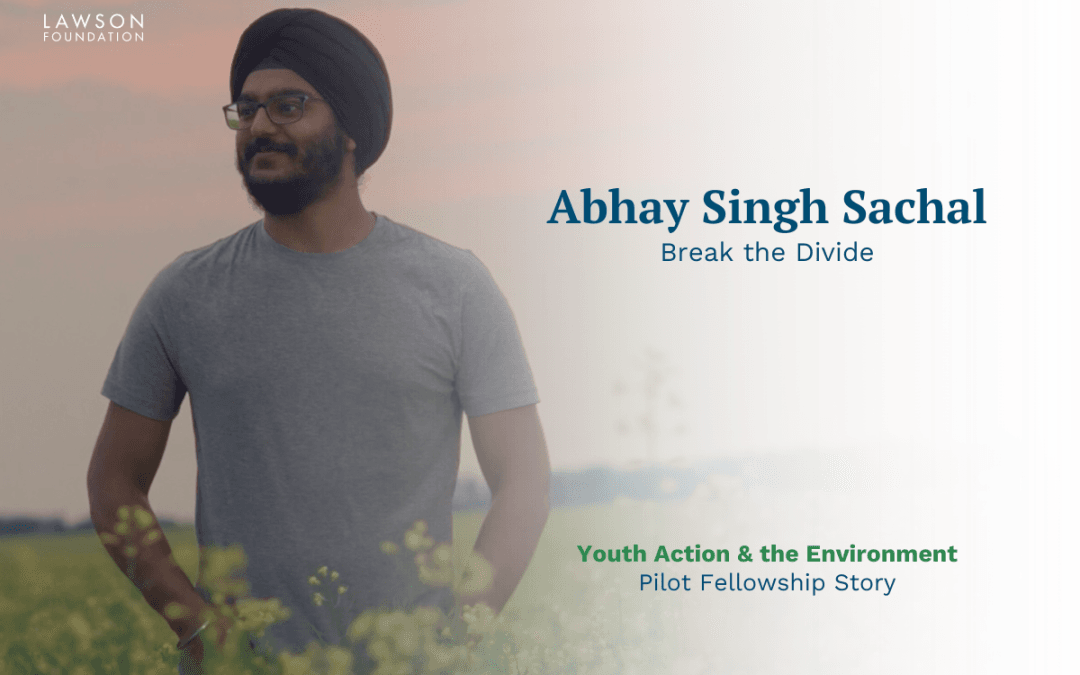
How does climate change make you feel?
That question sits at the heart of Break the Divide, the Saskatchewan-based nonprofit that Abhay Singh Sachal founded to help young people navigate their emotions about the climate crisis. Through climate-emotion circles in schools, community workshops, and facilitated conversations, Break the Divide creates space for young people to share authentically and connect.
“A big part of the work at Break the Divide is actually connecting people with their communities, connecting people with their identities that actually do hold a lot of resilience, hold a lot of knowledge on how to navigate this world at an individual and at a community level too.”
Abhay has been thinking about these questions since his early teenage years, when, during a trip to the Canadian Arctic, he saw firsthand the impacts of climate change on our planet. Today, while running Break the Divide, he is also completing a master’s degree in Educational Psychology, bringing both lived experience and academic background to his work.
Climate Resilience and Emotional Resilience
When asked about the connection between environmental action and human wellbeing, Abhay is direct.
“They’re inextricably connected,” he says. “I think we’re at a stage of a climate crisis where many public health systems, many organizations, and governments are shifting solely to adaptation. I think we still have a lot of work to do in mitigation to reduce the worst effects of climate change, but centring human health and wellbeing, centring how we feel and what our lives look like in this future uncertain world.”
Through his studies and years of facilitating conversations with young people, he has come to see resilience at the individual and community levels as the same process.
“Centring that process of resilience building in our communities, that’s where I see the true intersection. Resilience at the individual or psychosocial level and at the community level for climate resilience. Those are the same.”
For Abhay, this work shows up in practice as much as in theory. “When we have language to talk about where we’re at, we feel less stigma. Sometimes we feel shame about having emotions. I’m here to say, it’s okay to feel this way. It’s a sign that we’re alive.”
The Fellowship Year: Intentionality
When Abhay entered the Lawson Foundation’s Youth Action and the Environment Pilot Fellowship, Break the Divide was already active, with programs running and a small team taking shape. He applied with ambitions of reaching 250 schools.
“It brought a level of intentionality to our work, strategize, but then also think big and imagine what’s possible.”
During the fellowship year, Abhay worked with roughly 10 schools while turning his attention to the organizational foundations that Break the Divide had bypassed in its urgency to deliver: systems, workflows, theory of change, and impact mapping. It was the work that, as he puts it, “most organizations will do in the beginning,” but that Break the Divide had skipped because they “started doing so much without having done the building work.” Monthly coaching with the fellowship’s leadership coach helped put this in perspective. “In picking his brain and asking questions, it became more clear that this is just stuff that takes time,” Abhay says.
From Project to Organization
Through the fellowship, Abhay made a shift he describes as fundamental. “I’ve absolutely made the jump from youth-led project to running an organization, and this could be a job, and this could be a great job.”
The small cohort of four fellows, the long-standing relationships within the Lawson team, and a year of sustained engagement communicated something that other grants had not.
“It felt different with Lawson. In part because of the small cohort of four, in part because of the intentional time that was spent together,” he says. “Lawson actually believed in us as fellows. It wasn’t a random one-off thing.”
How he leads has changed, too: “There’s no longer an insecurity that’s driving me to take control. Instead, it’s a more regulated leadership where I can delegate, and I can share responsibilities, and I can actually work with people who are better than me at certain things and lean on their judgment.”
And his relationship to the work itself. “Break the Divide could fail. It ends, no more funding, no more programs. And I’d be okay. I think to a large extent, my sense of self-worth, like how I feel about changemaking, is no longer solely tied to Break the Divide. I see many avenues for myself to create change and to make a difference.”
Where Things Are Going
Today, Break the Divide is a team of three: Abhay as executive director, a full-time program manager, and a part-time communications lead, along with volunteers. The organization is preparing to launch its Climate Education and Resilience Program in 100 schools across Saskatchewan, Alberta, and Manitoba in September 2026, using trained volunteer facilitators who are under 30 and paid honoraria for their work.
As Abhay also finishes his master’s in Educational Psychology, a new question has emerged, which he is still sitting with: whether to pursue full licensing as a registered psychologist in Saskatchewan or to go all-in on Break the Divide.
“In working on this work over the past two years, for me, it’s absolutely opened my eyes up to more of the immense possibilities of doing the broader resilience and adaptation building work.”
His advice for other young people considering environmental leadership: “This is the future, and you can’t go wrong in trying to make the environment and our climate and the planet a better place, and that always involves people.”
Learn more about Break the Divide on their website and connect with Abhay on LinkedIn.
Amanda Mayer
Latest posts by Amanda Mayer (see all)
- 2025 Annual Report and Celebrating 70 Years of Impact - 25/06/2026
- Sabrina Guzman Skotnitsky – Pilot Fellowship Story - 11/06/2026
- Abhay Singh Sachal – Pilot Fellowship Story - 11/06/2026