
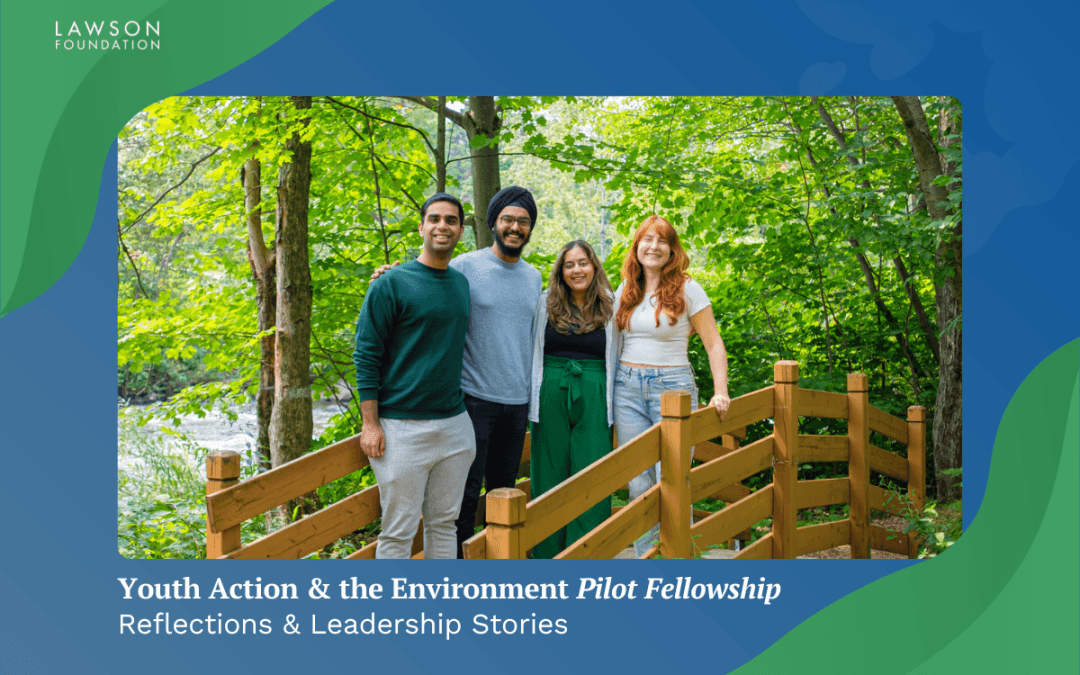
In late 2025, the second class of the Lawson Foundation’s Youth Action and the Environment (YAENV) Pilot Fellowship culminated after 12 months of flexible financial support, leadership coaching, mentorship, and wellbeing support to four young environmental leaders.
The purpose of the pilot fellowship has been consistent across both years: to support recipients, understand their needs and aspirations, and fill a gap in resources directly available to them. This journey of learning for the Foundation has been guided by a consistent “double bottom line” of strengthening youth leadership and civic engagement, and encouraging connection to nature and environmental action, with emphasis on young leaders who have faced systemic social, cultural, or economic barriers in their journeys.
The pilot fellowship has been a new experience for the Foundation since its inception. The second year provided a valuable opportunity to build on initial feedback and evaluation, support a second class of fellowship recipients, and deepen the lessons we now carry forward in our continued commitment to Youth Climate and Nature Leadership.
The Second Year Pilot Fellowship Class
In 2024, the Lawson Foundation welcomed four new YAENV Pilot Fellowship recipients, Abhay, Sabrina, Smiely, and Inaam, who shared a common focus on the intersection of environmental action and holistic human health and wellbeing. This thematic alignment, an intentional shift based on year-one feedback, was grounded in the value of connecting with others working on similar challenges, sharing stories and common challenges, and enabling deeper collaborative relationship-building among fellowship recipients.
Another addition for year two was the in-person kick-off gathering in Wendake, Quebec, which connected everyone together early in the process, including the support team. Recipients described the sense of community and shared purpose formed during this gathering as a highlight. Its impacts rippled throughout the fellowship year, sparking powerful peer connections that recipients identified as one of their most valued experiences.
To support their work and journeys, recipients received financial support, including a $15,000 stipend and up to $10,000 for project expenses. This was paired with skill coaching and training, mentorship, and a self-directed approach that placed trust in recipients to co-design their own fellowship paths. A dedicated Wellbeing Coach was also added in year two, recognizing the heavy demands on the shoulders of the young leaders – especially those facilitating discussions about climate grief and environmental anxiety while also managing their own projects, studies, and commitments.
As was the case in year one, fellowship recipients strongly highlighted the impactful support from the fellowship leadership coach. Through monthly calls and strategic guidance, this mentorship helped recipients advance their projects in many ways, from building organizational infrastructure and developing revenue models to managing teams and forming partnerships. Recipients shared that they valued gaining new practical knowledge and actionable recommendations and planned to continue mentorship beyond the fellowship.
Each recipient’s story was captured in a documentary film, with the support of producer Marium Vahed, who had been a fellowship recipient in the first year.
Meet the Second Pilot Fellowship Class

Abhay Singh Sachal
Abhay Singh Sachal is the founder of Break the Divide, a Saskatchewan-based organization working at the intersection of climate education, resilience, and mental health. He is completing a master’s degree in educational psychology at the University of Regina. Through the fellowship, Abhay grew Break the Divide from a youth-led project into an organization with a team and programming running in schools across the prairies.
Read Abhay’s fellowship story

Sabrina Guzman Skotnitsky
Sabrina Guzman Skotnitsky is a climate justice advocate, artist, consultant, and researcher based in Victoria, BC. Her initiative, Creating Climate Resilience, grew out of her master’s research at the University of Victoria, exploring how visual artmaking and group dialogue can help people process their emotional responses to climate change. Through the fellowship, she brought that research into community settings and is now building a growing community of practice in the field.
Read Sabrina’s fellowship story

Smiely Khurana
Smiely Khurana is the founder of Climate Wellness Network, a Vancouver-based initiative that creates spaces for people of all ages to connect with their feelings about climate change and with each other, through climate cafes, art workshops, and nature walks. Through the fellowship, Smiely built a team, developed an intergenerational approach to the work, and began exploring how to support others in starting similar initiatives in their own communities.
Read Smiely’s fellowship story

Inaam Chattha
Inaam Chattha is the founder of Green Mind, an organization focused on making climate knowledge accessible to young audiences through workshops, children’s books, and creative resources. He is a medical student in a dual-degree program at the University of Toronto, studying medicine and pursuing a master’s in engineering. Through the fellowship, Inaam expanded Green Mind’s work and is now transitioning its leadership to a collaborator while applying the same approach to healthcare sustainability.
Read Inaam’s fellowship story
What We’ve Learned
The evaluation of the pilot confirmed that the fellowship strengthened youth leadership and civic engagement and encouraged connection to nature and environmental action.
All eight recipients reported gaining significant confidence in themselves as environmental leaders, due to a confluence of factors, from the validation of being selected for the fellowship, to the financial support that recognized the value of their work, to the experience of seeing their projects grow and attract partners and collaborators.
Over the course of the fellowship, recipients came to see themselves as credible professionals in the environmental sector, equipped with the skills, relationships, and organizational foundations to sustain their work over the long term.
One of the most consistent findings in the post-fellowship evaluation was the value of flexible, trust-based funding. The ability for recipients to use fellowship funds in self-directed ways, including compensating themselves for their work, was among the most appreciated aspects of the fellowship across both classes. This personal support provided financial stability and allowed recipients to prioritize their work without the expectation that their efforts as environmental leaders would go uncompensated.
The importance of peer connection and the need for deliberate facilitation to enable it were reinforced across both classes. Recipients expressed a desire to connect more with one another, to share experiences, and to build a supportive community. The second class made progress on this front through the shared thematic focus and the kickoff gathering, with recipients appreciating the shared sense of purpose these created.
Working directly with young people at this level of engagement was a significant grounding experience for the Lawson Foundation. We embraced the need to adapt as the two fellowship classes progressed, from how we structured engagement to how we balanced the fellowship’s self-directed design with the recipients’ desire for support and accountability. The fellowship also deepened our understanding of how emotionally demanding climate and environment work can be for young leaders, reinforcing the need for support that recognizes the whole of who they are and what they carry.
Looking Ahead
The Youth Action and the Environment Pilot Fellowship was launched, in part, to explore a clear gap in the existing support landscape for young environmental leaders and validate how direct financial and wraparound support could make a difference. The two fellowship classes confirmed the value and meaning of flexible funding, coaching, wellbeing support, and peer connection for young environmental leaders.
The lessons we learned along the way have deepened our understanding of the needs of young environmental leaders and will now be carried forward in how we approach our role as a funder, as we move to now focusing our support entirely on key infrastructure organizations that equip young people to address climate change and protect our natural world.
Amanda Mayer
Latest posts by Amanda Mayer (see all)
- 2025 Annual Report and Celebrating 70 Years of Impact - 25/06/2026
- Sabrina Guzman Skotnitsky – Pilot Fellowship Story - 11/06/2026
- Abhay Singh Sachal – Pilot Fellowship Story - 11/06/2026